Animators by day Animation teachers by night.

Thursday, October 20, 2005

Thoughts on hand poses


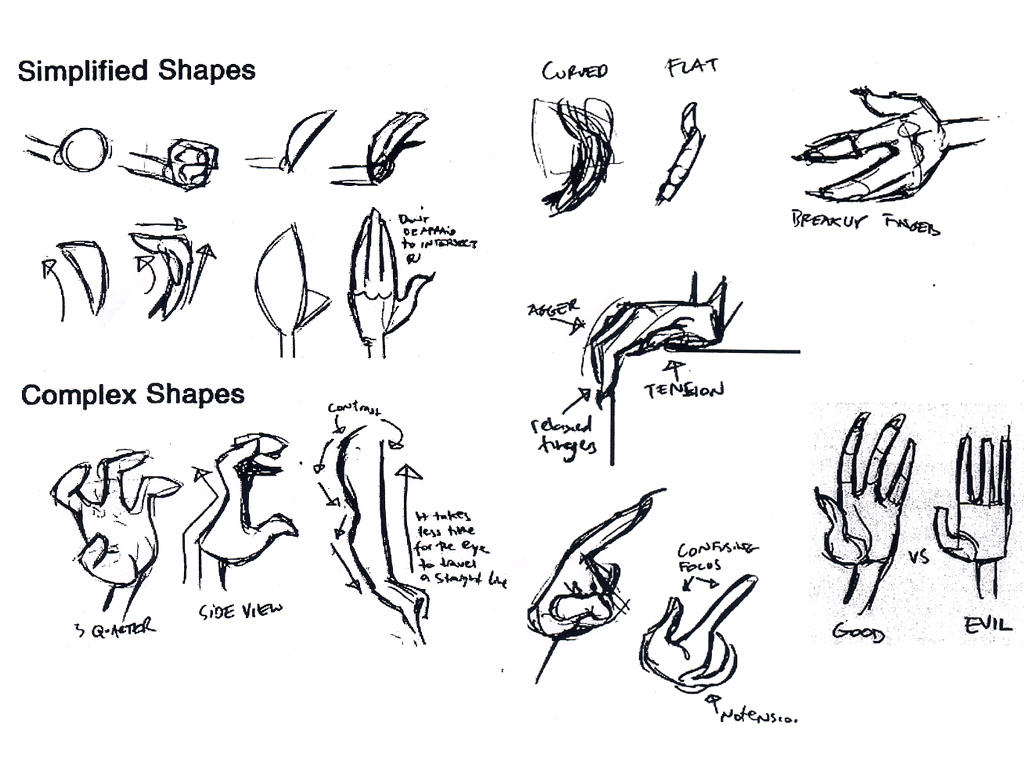
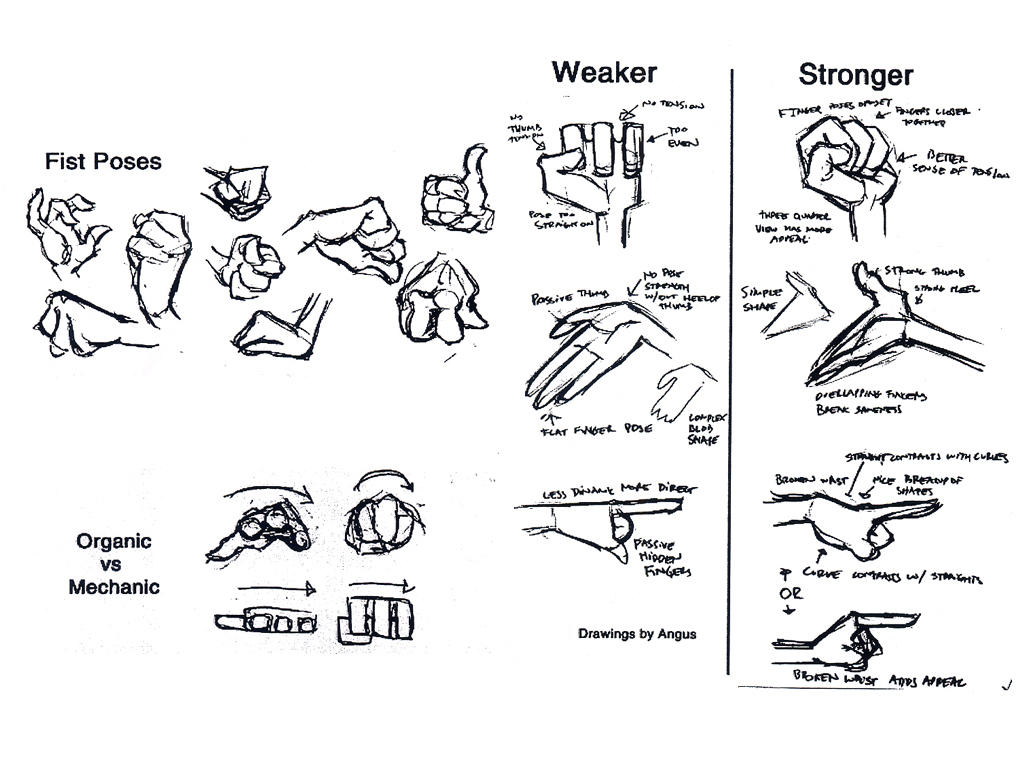
Hand poses can be one of the most important tools that the animator has to communicate attitude. They also can be some of the most difficult to master. If that weren't enough, computer animation allows for ugly hand poses never before possible in hand drawn animation. A few years ago I scribbled out a few do's and don'ts of hand posing. I don't know what happend to those drawings, but I was searching on Google images and found them. Click the images for larger versions. Apologies for the illegibility of my handwriting.

Enjoy-
Dr. A

Thursday, January 25, 2007

Pose to Pose w/ Layers


Since Andrew asked me to join him and the Pixar guys who teach at the Academy, and then Spline Doctors, the one thing that I've seen most consistently asked of students is advice on work method. Now, I'm a 2D guy. Not including one shot I did on IRON GIANT, INCREDIBLES was my first experience with 3D. I'm the least tech savvy of the fellows who started this blog (and for that matter, probably of the people I work with), but I figured it was about time I faced some of my fears and ventured forth from the safe harbor of my previous posts regarding performance and address some of your questions regarding 3D work method. Bear in mind, there are people far more talented than I who can address some of these issues, but I figured if an approach can work for someone like me....it can work for anyone.

A question that has come up in recent comments is, "How can I work pose-to-pose and still use a layered approach?" I don't claim to know the answer but I can share with you what has worked for me. First, I can't start a scene without knowing where I'm going. I will thumbnail every scene I get so I have a roadmap of the poses, beats, and attitudes that I know I am going for. I will then pose out my shot to match the thumbnails I've done. Bear in mind that some of these poses are going to be breakdowns of action that will help me map out the transition of movement from pose to pose. The biggest mistake I see students make working pose-to-pose in 3D is not thinking about the actual movement. They get lost in the poses and forget about the animation. I will then time out the shot with a series of holds not unlike on old-school, 2D pose test.

Once I feel that the overall timing and poses are working, I will immediately go into spline work polishing the main movement in the shot, working from the root, outward. I'll start off by invising geometry that might distract me (i.e. arms, legs, etc.) and bring into the spline editor the controls that define the main movement of the shot and start polishing. It may be the root. It may be the chest, neck, and head. It may be just an arm and a hand. Whatever it is, I will work from the inside out and I'll never polish any more than 3 to 4 controls at a time while I'm working in the spline editor. I will then work by tweaking and adjusting my animation and playblasting often. Even though you're working on a computer, animation is a very organic process. Work with your shot so it feels right to you. Don't let the computer dictate what you will accept. If it doesn't feel or look right, keep working at it until it does. If you still don't see it (and don't know how to get there) find someone more tech savvy than you and see if s/he can steer you to what controls you need to manipulate to get the results you're looking for. DON'T TAKE "NO" FOR AN ANSWER.

Once things seem to be moving the way I've envisioned, I will then start re-vising geometry and begin polishing outward. Please bear in mind though, that this approach will work ONLY if you have truly thought out your shot. Your original vision may evolve along the way, but you can't work like this without a clear idea of what you're going for. For that matter, whether it's 2D or 3D, you should never start animating before you know what you're going to do. Good luck and I hope this helped.

-Adam

Monday, April 30, 2007

Computer Animation and Drawing.

Many students get really intimidated when they are asked to draw or do thumbnails and show them in class. It's understandable, now days you don't have to be a great draftsman to get into animation school, heck for some schools you can have never drawn anything and get in. Computer animation has liberated many great animators, who may never been able to get into animation due to their lack of drawing ability. So on one hand the computer has allowed so many more people to access animation as a career and also allowed animation to become as big as it is these days, from computer games to the Internet, to commercials, feature animation etc. The flip side is that because of this access and the possible feeling that drawing doesn't relate to computer animation, the overall quality of the animation being produced is getting weaker and weaker. Many students now days can go to school learn everything there is about Maya, and graduate with only taking a few drawing classes and possibly never taking story or design classes. It's really a shame, for one that students don't demand story, design and drawing classes and also that schools don't find them important to the curriculum of computer animation. I had four main classes at Cal-Arts that repeated every semester for four years; Story, Character Design/Design, Animation, Life Drawing.

I've kinda gone off topic I'll come back to drawing now. The reason drawing is so important and life drawing in particular is that in one class, if taught well, you can learn about story, design, weight, physics, balance, squash and stretch, overlap, follow through, positive negative spaces, silhouette, composition, structure, rhythm, line of action, so many things all from a single drawing class. The other important thing is that if you keep going to class and keep drawing all the time you are constantly working on and being reminded of all of these things all the time. It can be really overwhelming to think about all of that stuff all the time but that's ok because your not just creating one drawing, you'll have many drawings where you can work on these things. One of the best things for me is to take one of the life drawings I did in class. Put a piece of tracing paper over it and try to look at the drawing and think about design or weight and re draw over my drawing thinking about one of the things mentioned for example, balance. Then keep repeating until you've addressed all the ideas, overlap, squash and stretch, silhouette, rhythm, etc, etc. I don't think you need to be a gifted draftsman to be a great animator but I do think you need to understand all the principles that are taught in good drawing, to be a great animator. Plus there is no need to be intimidated by drawing, only you are going to see them. You don't have to show your drawings, or thumbnails to anyone if you don't want to. While your in class don't even worry about the drawing who cares, worry about the process and thinking that goes on while drawing. If the drawing looks like junk but in the end you came away with a better understanding of how the forms work together and where the squash and stretch was working in the pose, that's cool. You'll remember that for next time and you'll remember that next time you sit down to plan out a shot or pose a character. I don't worry about the drawing anymore, I focus on trying to learn something while doing each drawing.

Just for fun and to show you that your drawings don't have to be great or pretty or nice or presentable I've included some thumbnails of mine from various films. These may or may not be pushed or the final poses for the characters in the shot. I tweak poses in the once they are in the computer, when I'm working to the main camera. Here I'm really trying to get and idea of what the pose will be and also what my acting is gonna a be and how it's going to move. I take a lot of notes along with the drawings to help describe motion, arcs, antics, or ideas that I can't draw. They are the road map of my shots but not always the final destination.

-Dr. Stephen G.


Monday, December 19, 2005

Gestures - Part 1


Gestures in animation can be so many things. I recently gave a talk on gestures for Animation Mentor. The talk really helped me delve into what a gesture is and why people do them. Gestures can be signals that tell a person how you are feeling. Some are primary and others are secondary. A primary gesture might be the one on the photos I grabbed from various sources. The fist in the air says "I have won" or celebrates something. The meaning of your gestures really depend on the situation and the character. As seen in the photo of the golfer, his way of celebrating is much more low key, as it should be on the golf course.
A good example of a secondary gesture might be a person putting his hand up to his mouth to cover a cough. It's an almost involuntary thing and it also tells the person seeing this that he is sick.

In animation, we tend to think of gestures as something that accompany dialogue. Its very easy to make boring choices when you are animating. Myself included, sometimes I just don't think things through. You really do need to explore all the possibilities to make your scene fresh. Here are a few tips.

1) Avoid twinning
2) Try to stay away from over used gestures such as the W pose or the point.
3) Think about your character and what types of gestures they might use.
4) Try to come up with a gesture that is interesting
5) Don't gesture. If it doesn't need to be there, then don't use one
6) Do your homework... Research, Thumbnail, people watch.


I have to say, I have been guilty of having a character gesture too much like myself (in the case of Monsters with Mike Wazowski). For that character, it worked, but I am always struggling to come up with interesting ideas and poses. Heck, actors can do it, why cant we?

I heard a great exercise that actors were doing in a class I was sitting in on. Go out and people watch for a few hours and take 3 gestures from different people and use them in a scene. It worked out great. One of the actors was stroking her hair, waving and putting her hand to her mouth. I thought it was a great way to study gestures.

Try it out and let me know how it works... If only I could get my students to do the assignment....

Some great reading for this type of thing is:
MANWATCHING: A FIELD-GUIDE TO HUMAN BEHAVIOUR. Desmond Morris
and GESTURES: THEIR ORIGINS AND DISTRIBUTION by Desmond Morris

http://www.desmond-morris.com/books.php


Happy Holidays,

Andrew

Tuesday, November 07, 2006

Let me hear your body talk!


Leave it to the refrain of a campy, Oliva Newton John, 80's pop hit to clearly lay down an important principle of strong acting. Body language. It is something that I've been looking at and paying more attention to in my own work over the years and is something I find consistently lacking in student work. Mike Wu and I gave a talk in our Pixar 2 class at the Academy on this very topic not too long ago. How a character holds him/herself physically provides a tremendous amount of information to the audience and provides the real truth in a scene as to who your character is and how he/she is feeling. The body language may support dialogue being spoken or, in appropriate circumstances, completely contradict it. Of course, in situations where there is no dialogue the body is your only means to communicate to the audience how your character feels. Why do you think news shows bring in body language experts after presidential debates or press conferences? It's because when it comes to communication, the truth is always in the body.

Having said that, bear in mind the context and content of your scene. The rookie move I often see is to start adding a bunch of extra poses and peppering the animation with arbitrary gestures that don't support or, worse yet, take away from what you're trying to communicate. Start from the ground up. What's going on? A guy is asking a girl for a date. How does he feel? Nervous. What graphic elements could I put into my pose that will help communicate that? Concave curves. A sunken or deflated line of action. How is he holding himself physically? He can't look her in the eyes. He's holding his arms in tight around himself. How is he moving? He can't stay still. Just as your animation should build in a layered fashion, working from the root outward, so should your performance build. Start with content and context, and gradually layer elements which help support those ideas.

Mike Wu showed a clip in class from "Godfather II" that shows a brilliant example of skilled, well choreographed body language. It takes place shortly after young Vito has killed the old Don of the neighborhood. He is now speaking with a landlord on behalf of a friend "asking him for a favor". Watch it with the sound off like we did. It is obvious that Vito wants something from this man and the landlord is very clear about his dismissive attitude toward this thug who has the audacity to demand something from him. Now, in the very next scene, when the landlord learns from the neighborhood who Vito is and what he has done, the physical changes are sheer poetry in motion. The landlord has completely changed his physical demeanor. Vito, on the other hand, has what amounts to be a single pose that says more about how he feels than any line of dialogue ever could. Absolute gold!

Study similar examples and bear these things in mind as you work out the foundation of your performances. The eyes can't do it all. Factoring in these elements is what separates the great acting from mediocre or bad. Now, as Olivia would say, "Let's get physical."

Monday, September 04, 2006

Physicality in animation


If someone says, you need to work on your physicality, what are they really saying? This is such a large topic. Making something seem physical can be related to weight or how the character holds themselves. It can be how a gesture feels wooden and non-physical. Lets talk a bit about the latter. When a character makes a hand gesture, it not only needs to communicate what the character is doing, but needs to feel as if the character has flesh and bones underneath. You need to understand the anatomy of the character you are animating. One of the biggest things that makes computer animation not look so good is that people do not pay attention to this. The computer will and can ruin good poses if you do not do the in-betweens and breakdowns correctly. It has no knowledge of all those things you should be putting in there likes arcs, overlap, slow ins, cushions, overshoots, anticipations, squash and stretch, straights and curves, contrast, etc, etc, etc.

If you want a sample case, I was working on the teaser for Monsters Inc. Mike does a gesture and then drops his arm. I really wanted to understand how that works so I did a bit of reference and it helped me understand the weight the arms has and how it comes to rest. A lot of what I am talking about has to do with this. Residual energy. I'll get into this more at a later time, but residual energy really has a lot to do with how your character recovers form hitting a pose or gesture. In essence it is overlap and follow through. One thing you do not want, is for the character to become over animated, so you really need to understand how to use it and where it is called for.

I hope to put together a better set of examples and post them at a later date.

-Andrew

Monday, October 31, 2005

Who Are Your Influences?


We decided to compile lists of our top 10 most personally influential animated films. These are not necessarily the best animated films, nor are they necessarily our favorites. They are films that inspired us to become animators and influenced our work.


Dr. Angus' Top Ten Most Influential Animated Films

10. Bambi- Many people have been scarred by Bambi's mothers death. I'm no different. Bambi is a film that is equal comedy and tragedy. Recently, I watched it again and found it to be refreshingly simple and honest. It's a good antidote to noisy modern film making. I wish people would make movies like this again.

9. The Adventures Of Mark Twain- Good luck finding this one. I grew up in Portland and followed everything that Will Vinton Studios produced. I worshiped The California Raisins so when a feature was released, I was first in line. The film has it's problems, but it's worth seeing for Barry Bruce's character designs alone. The humans in the film are caricatured brilliantly. I wish more films were able to create a world this consistent. Claymation has a warmth that CG cannot match.

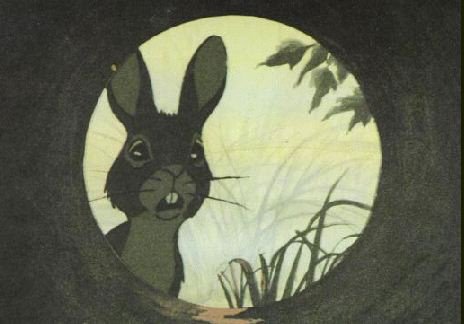
8. Watership Down- For some reason 1970's animated films were largely dark and depressing. The rabbit carcasses in this film still haunt me. Bloody Bunnies are not the best thing for a child. I'm sure if I saw it again it wouldn't seem so gruesome, but I'd prefer to keep the memory of my enjoying this film. Just like Goonies.

7. Toy Story- What can you say? Still holds up. What I hope isn't lost with the passage of time is how revolutionary this film was story-wise. Yeah, it was the first all CGI film, but it was the story that set it apart. At the time, the powers that be were convinced that the only animated films that people wanted to see were broadway-style musicals with animal sidekicks. Of course they were wrong.

6. Aladdin- The Arsenio jokes were old when it came out, but the Eric Goldberg Genie stuff is amazing. I think Robin Williams gets a lot of credit for Mr. Goldberg's work, but whadaya gonna do? If you want to be famous- get out of the cartoon business. *

5. Iron Giant- Like everybody else reading this I saw it opening day and think it's the best thing ever and the most overlooked gem of our time and you can't believe how bad the marketing was and so on. Doesn't mean it isn't true. Everything is great about this film. At the time I heard some complain that the animation was sub-par because it wasn't constantly moving. Well those people are wrong. Animated films would be a lot better off if they weren't always moving. See it again.

4. Alice in Wonderland- Walt was reportedly disappointed with this film and seeing it recently, I can understand why. The limitations of the budget and running time don't allow for a faithful adaptation of Lewis Carroll's classic tome. That said, the design is incredible and the animation is stunning. Some of my favorite scenes are the Doorknob bit and the Tea party.

3. Sleeping Beauty- As a kid, this was the best Disney film- largely because of the ending. You had 3 fairies equip the hero with a sword and shield and a cool villain that turned into a Dragon. What more could you ask for? Seeing it again, it kinda drags. The hero is dull and Briar Rose- while beautiful, is not that interesting either. The 3 Fairies are both the focus of the film in both story and animation. It's as if they built the film around these characters so that the animators could explore a variety of acting ideas that they were interested in exploring. That in itself is pretty cool. The design is well stylized, and Eyvind Earle's square trees are neat.

2. Wind in the Willows/The Legend of Sleepy Hollow- A toad that drives a car and A lanky dude that rides a horse. Pure gold. Creepy and engaging. The Bing Crosby numbers are a good match for Sleepy Hollow. They give the film a timeless innocence that contrasts nicely with its chilling ending. The Ichabod animation is ridiculously cool.

1.Who Framed Roger Rabbit- This film is kinda all over the map, but it hit me at the right time. I was 13 when it came out, and after I saw this film I knew what I wanted to do with my life. The film makers went to so much trouble to do things with props and sets that the computer can do easily (but not as well somehow). I think that counts for something. Plus you'll never see Donald Duck in the same frame as Daffy Duck ever again (unless Wal-Mart buys both AOL Time Warner and Disney).

Honorable mention:

G.I. Joe: The M.A.S.S Device- Can the Joes defeat Cobra to recover the missing elements?
The Hobbit- Good story weak execution. But Smaug's Eye beams were cool.
Fantastic Planet- French, Freaky, and Amazing.
The Sword In The Stone-Not the best story, but the best animation.


Dr. Stephen G's Top Ten Most Influential Animated Films

10. Sleeping Beauty
- So rich too look at with great color and design, and the mastery of Marc Davis' Maleficent.

9. 101 Dalmatians
- Again Bill Peet!!!! with animators at the top of their game.

8. Jungle Book
- Not as refined as Lady and the Tramp or Peter Pan production value wise, but the nine old men where at the top of there game animation wise. Plus the xerography process of putting the drawings to cel left more of the animators hand in the final images on screen. That process alone to me was like a magician just barely showing you his magic trick.

7. Iron Giant
- Simply Perfect. Refer to my Dumbo comment. Replace Baby Mine with the sequence where the giant finds out why he was built and replace Bill Peet with Brad Bird.

6. Toy Story
- During the dredge of musicals Toy Story was as innovative as they come not only to the computer graphics industry, But more so to animated story telling.

5. Knick Knack
- Short Film by John Lasseter When I saw this film back in 1991 or '92 I knew I was gonna work at Pixar someday. The ideal short film perfect in every way.

4. Peter Pan
- The color design, layout and animation is some of the best ever done. From Ward Kimball crazy Indian chief, to Frank Thomas powerful acting with Captain Hook, and Ollie's humor with Smee It's hard to say that Peter Pan isn't one of the best animated films ever.

3. Pinocchio
- When I was younger I would just watch this over and over and over, it got me into animation, got me into drawing and still inspires me today. The Watercolor backgrounds, the crazy multi-plane camera move at the beginning, ripple glass for the underwater scenes...they were breaking new ground. Plus I'll never forget the power of Bill Tytla's Stromboli and Frank Thomas' animation of Pinocchio during the got no Strings song.

2. Lady and the Tramp
- Absolutely beautiful to watch from the production design to the animation, super inspiring to me.

1. Dumbo
- Simple and Heart Felt. The Baby Mine Sequence shows you how powerful animation can be. Plus it's all Bill Peet!


Dr. Gordon's Top Ten Most Influential Animated Films

I wasn't a huge Disney fan. More a fan of Warner Brothers Cartoons.
This is in no specific order.

1) Warner Brothers cartoons in general. Some of my favorite are feed the kitty, duck amuck and most anything Chuck Jones directed during the Golden age. These cartoons were amazingly timed and the drawings were funny. I think they influenced my sense of timing.

2) I remember being really blown away by Toy Story. I had seen the shorts and commercial done by Pixar and knew they were the best, but this film just blew me out of the water. I knew that Pixar was doing some of the best stories out there.

3) Fantasia - I really love the idea of music telling stories and doing it without dialogue. The night on Bald mountain sequence is amazingly done. Great mood.

4) The Secret of Nihm - As a kid I really loved this film. It was a bit over animated but the story was one that I read as a kid. I remember the performances of the OWL and Nikodemis. I know its not everyones favorite, but I did enjoy it.

5) My Neighbor Totoro... I love this film because of the time that Miyazaki takes with the moments in the film. It also takes me a world that is so wonderful.

6) Wallace and Gromit - My favorites are: The Wrong Trousers and Were Rabbit. Aardman's attention to detail is amazing and all the characters are fun to watch. It just goes to show again that the characters performances are just as important as the "poses" Gromit has more heart than most characters in Live Action Films.

7) Aladdin - I always had fun watching this film and thought the Genie was very well done. Some of the songs went well with the animation.

8) Akira - As far as Japanese Anime goes, this one is awesome. Its a classic. Great effects work too.

9) Monk and the Fish and Father and Daughter. Michael Dudok De Wits films just have a great feel to them. They make me want to do short films and explore characters. I love the simplicity of the characters and how fun they are to watch.

10) Jungle Book- It wouldn't be fair to not include work of the 9 old men. I appreciate what Disney's did now more than I did before I got into animation because I can see how amazing the performances of the characters are. I love Milt Kahl's work on Shere Kahn. Also, all the work done with Baloo and the snake character is amazing. Great choices. It wasn't so much the story that blew me away, but more the animation.